無料Microsoft AZ-104: Microsoft Azure Administrator Exam実際試験 -信頼的なCertJuken AZ-104関連日本語内容
Wiki Article
2026年CertJukenの最新AZ-104 PDFダンプおよびAZ-104試験エンジンの無料共有:https://drive.google.com/open?id=1DnY1HcVzh8pNjmCHfBK4VGyQ-ypJ_ED9
MicrosoftのAZ-104認定試験はIT業界の中でとても普遍的な試験になります。試験の準備は時間とエネルギーがかかります。時は金なり社会に時間を無駄しないようによいツルを探し出されるのはみんなの希望です。CertJukenのMicrosoftのAZ-104認証試験の問題集は君の20時間だけかかりますよ。
試験は、仮想ネットワーク、Azure AD、ストレージ管理、仮想マシン、およびAzure Automationなど、Azure管理に関連する広範なトピックをカバーしています。試験はまた、Azure Security Center、Azureポリシー、およびAzure Identity Managementなどのセキュリティとコンプライアンスに関連するトピックもカバーしています。
Microsoft AZ-104試験、またはMicrosoft Azure管理者試験とも呼ばれるこの試験は、Microsoft Azureサービスの管理と監視の知識とスキルをテストするために設計されています。この試験は、Azureリソースとサービスの実装、管理、および監視に責任を持つ個人を対象としています。
AZ-104関連日本語内容、AZ-104資格難易度
Microsoft AZ-104認証試験を通ってからかなり人生の新しいマイレージカードがあるようで、仕事に大きく向上してIT業種のすべての方は持ちたいでしょう。多くの人はこんなに良いの認証試験を通ることが難しくて合格率はかなり低いと思っています。ちっとも努力しないと合格することが本当に難しいです。Microsoft AZ-104試験を通るのはかなり優れた専門知識が必要です。CertJukenがMicrosoft AZ-104認証試験を助けて通るのウエブサイトでございます。CertJukenはMicrosoft AZ-104認証試験に向かって問題集を開発しておって、君のいい成績をとることを頑張ります。一目でわかる最新の出題傾向でわかりやすい解説、充実の補充問題などで買うことは一番お得ですよ。
Microsoft AZ-104またはMicrosoft Azure Administrator試験は、Microsoft Azure Servicesの管理と管理における候補者のスキルと知識を検証する認定試験です。クラウドリソースの管理、セキュリティ制御の実装、Azureサービスの監視と最適化、クラウド環境の全体的な健康を維持する責任を負う専門家向けに設計されています。
Microsoft Azure Administrator Exam 認定 AZ-104 試験問題 (Q522-Q527):
質問 # 522
You have several Azure virtual machines on a virtual network named VNet1.
You configure an Azure Storage account as shown in the following exhibit.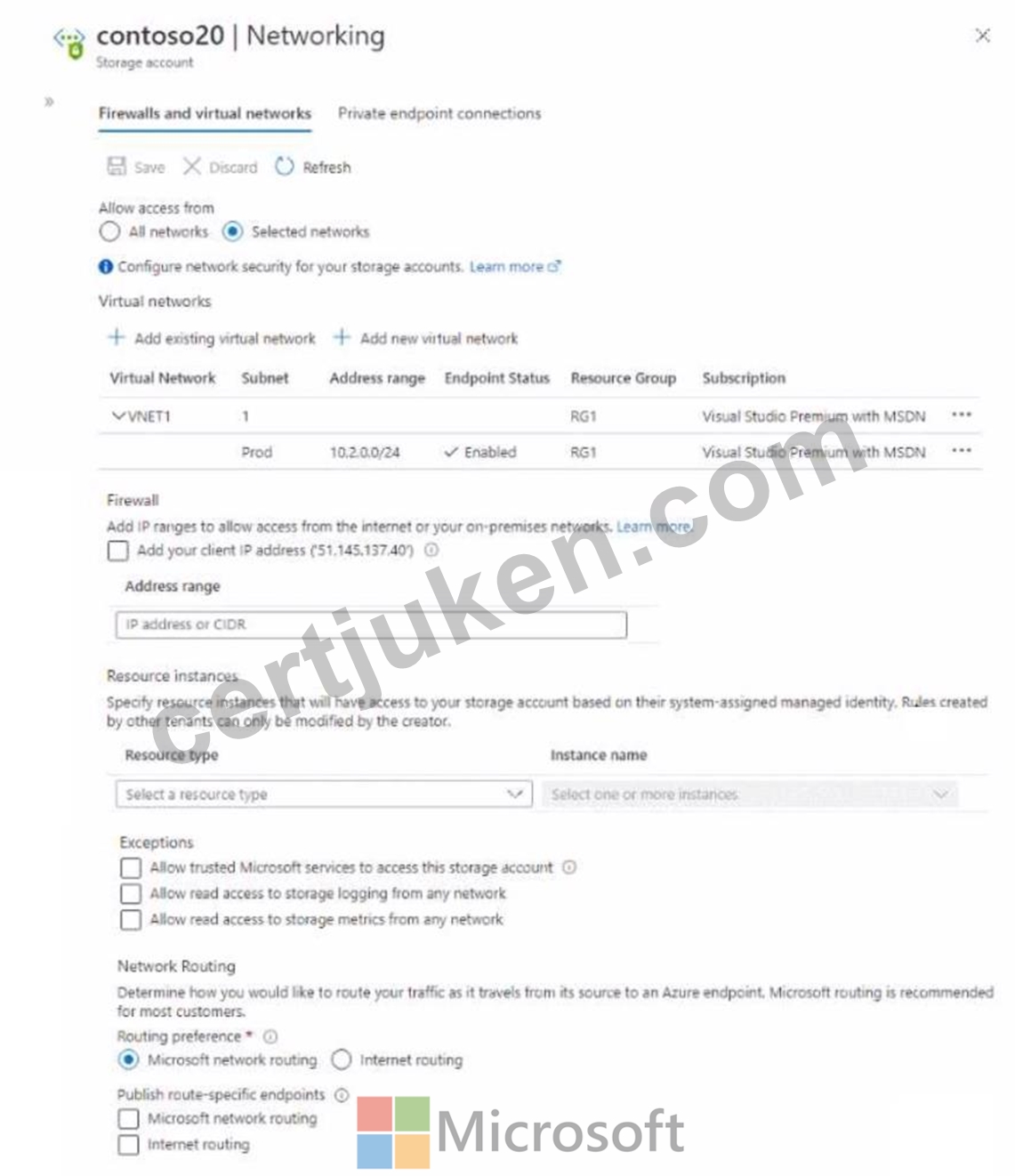
Use the drop-down menus to select the answer choice that completes each statement based on the information presented in the graphic.
NOTE: Each correct selection is worth one point.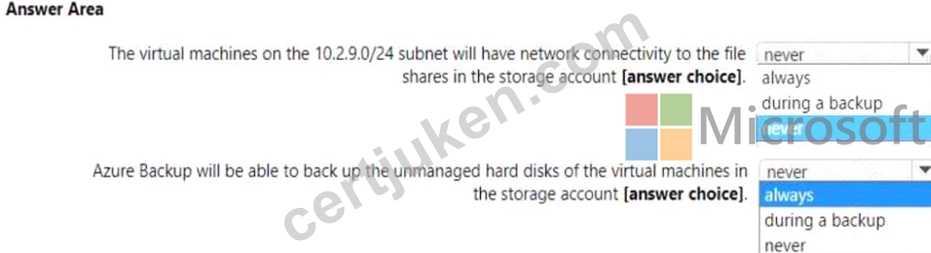
正解:
解説: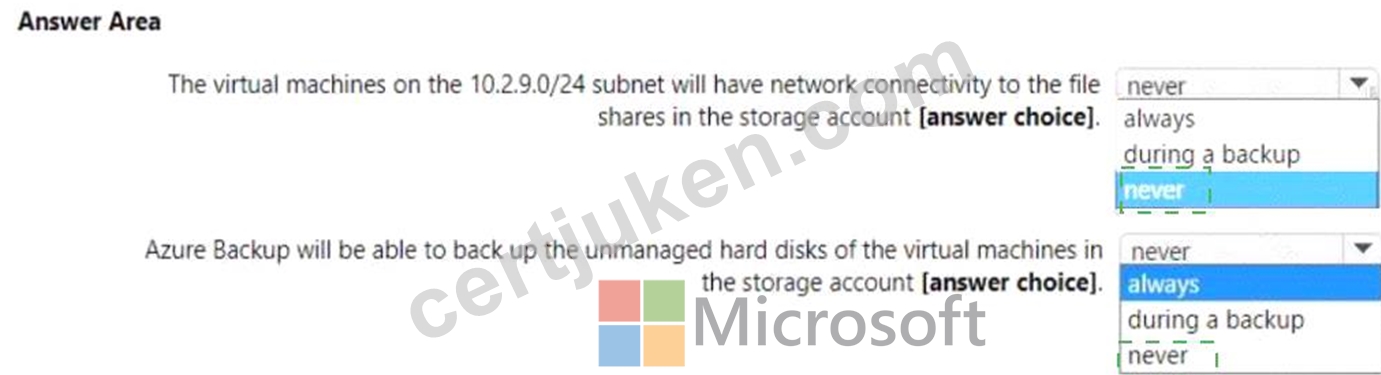
Explanation: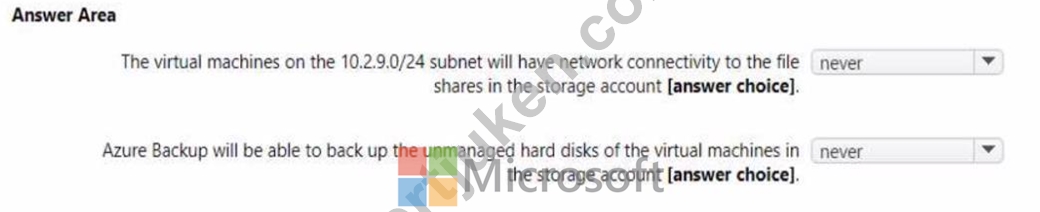
質問 # 523
You need to implement the planned changes for the storage account content. Which containers and file shares can you use to organize the content?
- A. cont1, cont2, share1, and share2
- B. share1 only
- C. cont1, share1, and share2 only
- D. cont1 and share1 only
- E. share1 and share2 only
正解:D
解説:
In the scenario, storage1 is configured as StorageV2 with Hierarchical namespace = Yes, while storage2 is configured as StorageV2 with Hierarchical namespace = No.
From Microsoft's Azure Storage Documentation and AZ-104 Study Guide, the following principles apply:
* A hierarchical namespace (enabled when the storage account has Azure Data Lake Storage Gen2 capabilities) allows the use of directories within containers to organize data.
* The hierarchical namespace provides directory and file-level structure similar to a file system. This is supported only for blob containers, not for Azure Files.
* Azure Files (file shares) do not depend on hierarchical namespaces and cannot have directories in the same way Data Lake Gen2 does - directories can exist inside the share but not in the blob container sense.
* The planned change states that you must use directories whenever possible to organize content.
Therefore, only storage accounts with hierarchical namespace enabled can use directory structures - that's storage1.
In this case:
* storage1 (Hierarchical namespace = Yes) # supports containers (like cont1) and file shares (like share1).
* storage2 (Hierarchical namespace = No) # does not support directories within blob containers (Data Lake structure).
Hence, you can use only cont1 (container in storage1) and share1 (file share in storage1) to organize content as required.
This is directly supported by the Microsoft documentation on Data Lake Storage Gen2:
"When you enable the hierarchical namespace for a storage account, you can organize objects into directories and subdirectories. This capability is available only for accounts configured for Data Lake Storage Gen2." Final Verified Answer: # B. cont1 and share1 only
質問 # 524
You have an Azure virtual machine named VM1 that connects to a virtual network named VNet1. VM1 has the following configurations:
Subnet: 10.0.0.0/24
Availability set: AVSet
Network security group (NSG): None
Private IP address: 10.0.0.4 (dynamic)
Public IP address: 40.90.219.6 (dynamic)
You deploy a standard, Internet-facing load balancer named slb1.
You need to configure slb1 to allow connectivity to VM1.
Which changes should you apply to VM1 as you configure slb1? To answer, select the appropriate options in the answer area.
NOTE: Each correct selection is worth one point.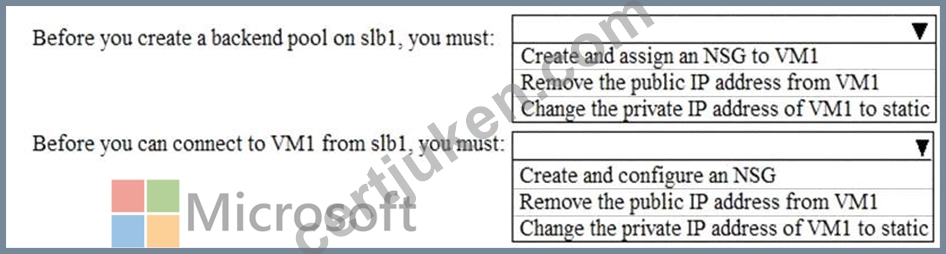
正解:
解説: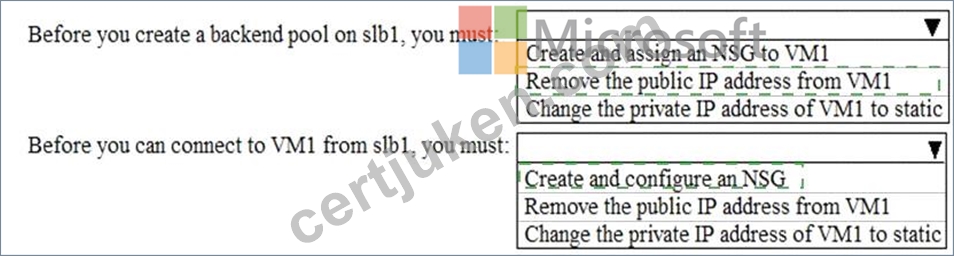
Explanation
Box 1: Remove the public IP address from VM1
If the Public IP on VM1 is set to Dynamic, that means it is a Public IP with Basic SKU because Public IPs with Standard SKU have Static assignments by default, that cannot be changed. We cannot associate Basic SKUs IPs with Standard SKUs LBs. One cannot create a backend SLB pool if the VM to be associated has a Public IP. For Private IP it doesn't matter weather it is dynamic or static, still we can add the such VM into the SLB backend pool.
Box 2: Create and configure an NSG
Standard Load Balancer is built on the zero trust network security model at its core. Standard Load Balancer secure by default and is part of your virtual network. The virtual network is a private and isolated network.
This means Standard Load Balancers and Standard Public IP addresses are closed to inbound flows unless opened by Network Security Groups. NSGs are used to explicitly permit allowed traffic. If you do not have an NSG on a subnet or NIC of your virtual machine resource, traffic is not allowed to reach this resource. To learn more about NSGs and how to apply them for your scenario, see Network Security Groups. Basic Load Balancer is open to the internet by default.
A screenshot of a computer Description automatically generated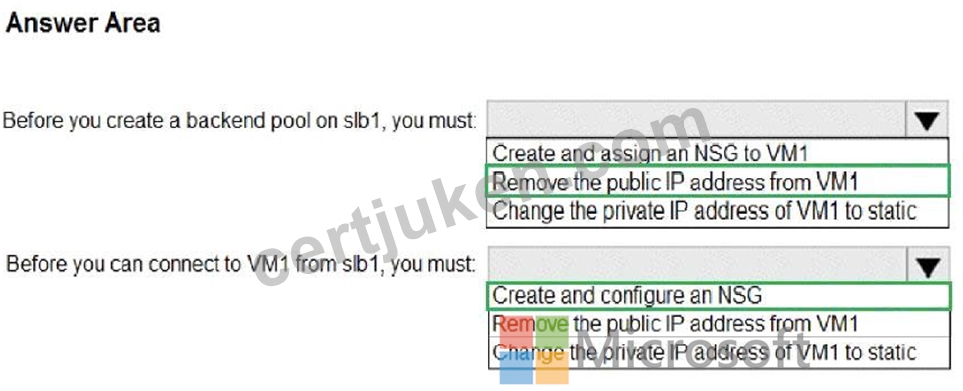
Reference:
https://docs.microsoft.com/en-us/azure/load-balancer/quickstart-load-balancer-standard-public-portal
https://docs.microsoft.com/en-us/azure/load-balancer/load-balancer-overview
質問 # 525
You have an Azure subscription that contains two virtual networks named VNet1 and VNet2. Virtual machines connect to the virtual networks.
The virtual networks n on-premises server named Server1 th
configured as shown in the following table.
You need to add the address space of 10.33.0.0/16 to VNet1. The solution must ensure that the hosts on VNet1 and VNet2 can communicate.
Which three actions should you perform in sequence? To answer, move the appropriate actions from the list of actions to the answer area and arrange them in the correct order.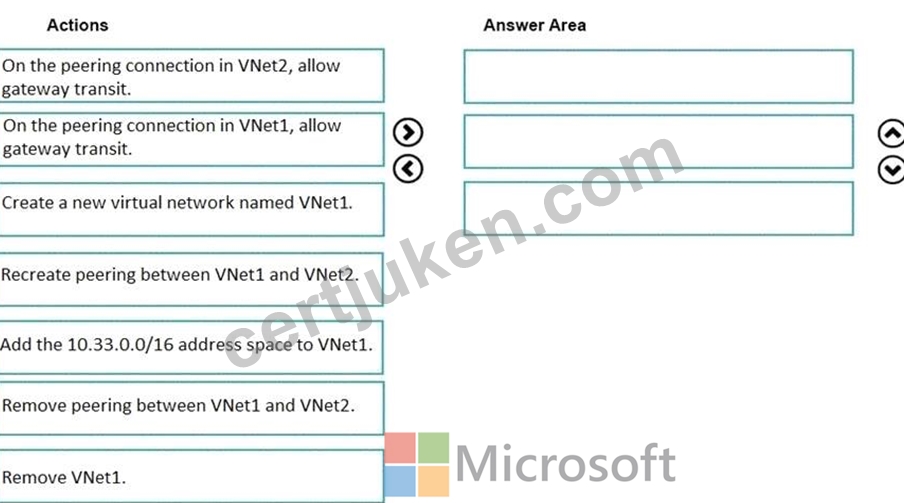
正解:
解説: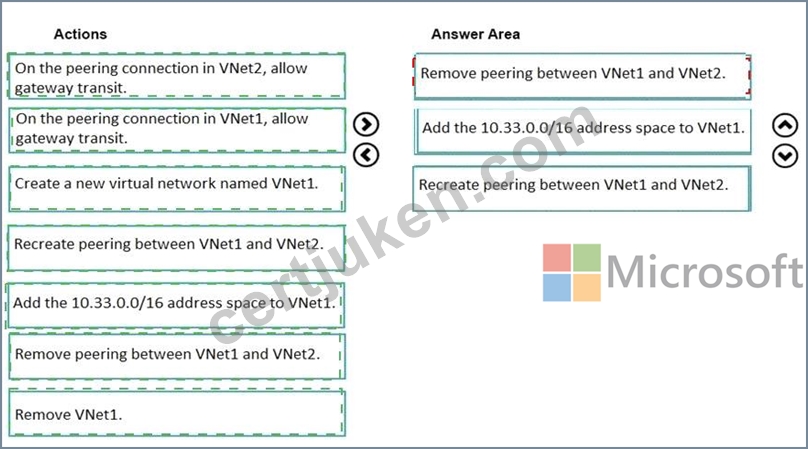
Explanation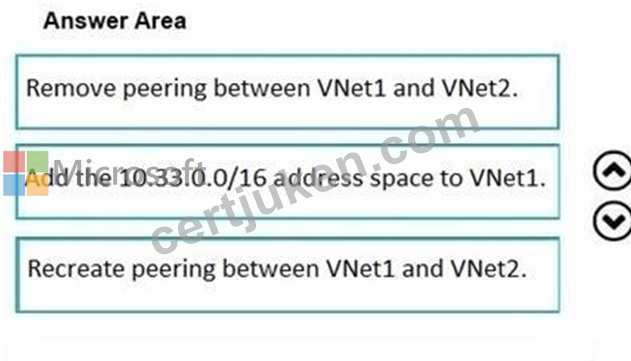
Step 1: Remove peering between Vnet1 and VNet2.
You can't add address ranges to, or delete address ranges from a virtual network's address space once a virtual network is peered with another virtual network. To add or remove address ranges, delete the peering, add or remove the address ranges, then re-create the peering.
Step 2: Add the 10.44.0.0/16 address space to VNet1.
Step 3: Recreate peering between VNet1 and VNet2
References:
https://docs.microsoft.com/en-us/azure/virtual-network/virtual-network-manage-peering
質問 # 526
Note: This question is part of a series of questions that present the same scenario. Each question in the series contains a unique solution that might meet the stated goals. Some question sets might have more than one correct solution, while others might not have a correct solution.
After you answer a question in this section, you will NOT be able to return to it. As a result, these questions will not appear in the review screen.
You have an Azure subscription named Subscription1 that contains the resources shown in the following table.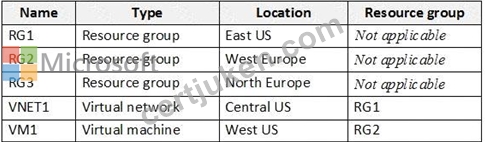
VM1 connects to a virtual network named VNET2 by using a network interface named NIC1.
You need to create a new network interface named NIC2 for VM1.
Solution: You create NIC2 in RG2 and West US.
Does this meet the goal?
- A. NO
- B. Yes
正解:B
解説:
Explanation
The virtual machine you attach a network interface to and the virtual network you connect it to must exist in the same location, here West US, also referred to as a region.
References:
https://docs.microsoft.com/en-us/azure/virtual-network/virtual-network-network-interface
質問 # 527
......
AZ-104関連日本語内容: https://www.certjuken.com/AZ-104-exam.html
- Microsoft AZ-104 Exam | AZ-104実際試験 - オフィシャルパス認証 AZ-104関連日本語内容 ???? 時間限定無料で使える▶ AZ-104 ◀の試験問題は【 www.xhs1991.com 】サイトで検索AZ-104最新な問題集
- AZ-104関連資格知識 ???? AZ-104最新受験攻略 ???? AZ-104実際試験 ???? ⇛ www.goshiken.com ⇚を開き、➥ AZ-104 ????を入力して、無料でダウンロードしてくださいAZ-104受験料
- AZ-104最新受験攻略 ???? AZ-104最新な問題集 ???? AZ-104試験番号 ???? ▷ www.passtest.jp ◁で使える無料オンライン版“ AZ-104 ” の試験問題AZ-104最新受験攻略
- 便利なAZ-104実際試験 - 合格スムーズAZ-104関連日本語内容 | 便利なAZ-104資格難易度 ???? 今すぐ▶ www.goshiken.com ◀で⇛ AZ-104 ⇚を検索し、無料でダウンロードしてくださいAZ-104試験内容
- AZ-104最新対策問題 ???? AZ-104関連問題資料 ???? AZ-104対応内容 ???? ☀ www.passtest.jp ️☀️を開いて( AZ-104 )を検索し、試験資料を無料でダウンロードしてくださいAZ-104試験情報
- 高品質-有効的なAZ-104実際試験試験-試験の準備方法AZ-104関連日本語内容 ???? 時間限定無料で使える《 AZ-104 》の試験問題は▶ www.goshiken.com ◀サイトで検索AZ-104最新対策問題
- AZ-104最新受験攻略 ???? AZ-104受験記対策 ???? AZ-104受験記対策 ???? ⏩ www.jptestking.com ⏪に移動し、{ AZ-104 }を検索して、無料でダウンロード可能な試験資料を探しますAZ-104試験情報
- Microsoft AZ-104 Exam | AZ-104実際試験 - 要求のために常に利用可能 ❓ Open Webサイト☀ www.goshiken.com ️☀️検索( AZ-104 )無料ダウンロードAZ-104試験関連情報
- AZ-104試験番号 ???? AZ-104試験関連情報 ???? AZ-104資格準備 ???? Open Webサイト“ www.jpexam.com ”検索➽ AZ-104 ????無料ダウンロードAZ-104模試エンジン
- Microsoft AZ-104 Exam | AZ-104実際試験 - オフィシャルパス認証 AZ-104関連日本語内容 ⏬ URL 「 www.goshiken.com 」をコピーして開き、✔ AZ-104 ️✔️を検索して無料でダウンロードしてくださいAZ-104勉強方法
- AZ-104勉強方法 ???? AZ-104試験内容 ???? AZ-104認定テキスト ???? 検索するだけで[ www.shikenpass.com ]から【 AZ-104 】を無料でダウンロードAZ-104問題集
- eternalbookmarks.com, bookmarkworm.com, socialwebnotes.com, siobhanoijl366361.slypage.com, www.stes.tyc.edu.tw, jimixqw212713.life3dblog.com, www.stes.tyc.edu.tw, gretawwsc139163.loginblogin.com, bookmarkjourney.com, estelletrpb526264.ssnblog.com, Disposable vapes
さらに、CertJuken AZ-104ダンプの一部が現在無料で提供されています:https://drive.google.com/open?id=1DnY1HcVzh8pNjmCHfBK4VGyQ-ypJ_ED9
Report this wiki page